
Like determining the success of everything else in our daily life, to determine how successful a training was, one has to know whether or not that training was able to meet the business goals, knowledge retention on new skills, or fill the knowledge gaps that led to the training. Performing training, while essential for employee development, is often not the easiest task nor the inexpensive one. Training programs require time, money, and extensive planning. So it is only natural that executives know how fruitful the training they invested on. There are various metric types to measure the efficacy of training programs.
In this article we will learn about the evaluation of training effectiveness, reasons one should do it, and most importantly, the ways to evaluate training program successfully. Let’s get into it then, shall we?
Employee Training Evaluation
If your employee is failing to understand a particular topic or struggling to meet company standards, appropriate training is required. But how do you know if that particular training was effective? Unless you cannot determine whether they have learned anything from the training sessions, understanding the efficacy of the program will be hard. An employee training evaluation system was designed to solve that problem.
Evaluating training means gathering data to asses if the training addressed employee problems, trained them to be qualified, and brought fruitful results on employee productivity, job satisfaction, etc. Various evaluation tools are available for evaluating an employee’s training effectiveness. This information not only helps to find the status of intended outcomes but also helps identify any problems or shortcomings with the training program for future reference. This measure generally falls into two groups and these are:
Measuring the Learning Outcome:
Learning outcomes refer to the learning aspect of the training like what techniques have been taught to employees for improved productivity and better service, what have they learned from the training, and so on.
Measuring the Training Process
Process measurements measure things that have to do with how the training was held, the participation of the employees, engagement, and teaching methods among other things.
Some reliable methods of measuring training effectiveness have emerged for evaluations such as:

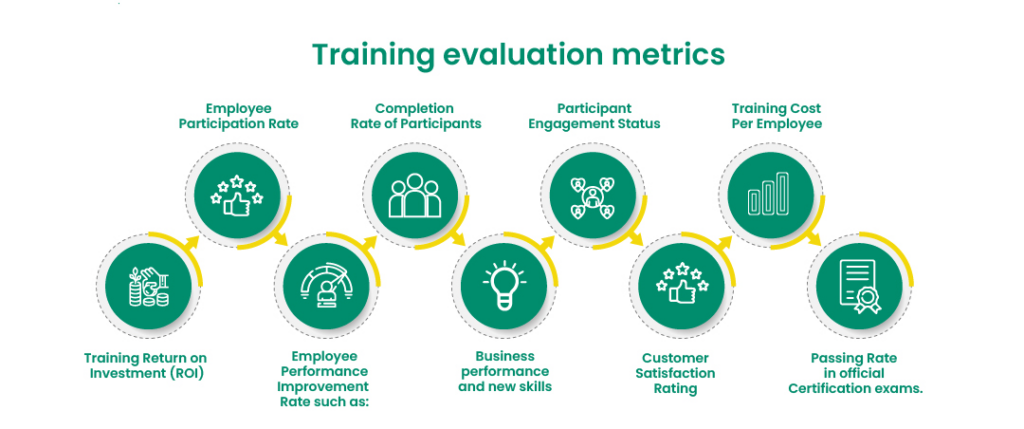
Training Evaluation Metrics
During training or even after the training, executives should measure the performance and effectiveness of the training program. When you organize a training program for your company, a lot of money gets invested in that. So it is only natural that you would want to track training data for evaluation.
Training metrics are important in understanding training success and can assist with making changes or improvements. Different metrics can be tracked depending on the training you have chosen and the learning outcomes you want. Typical measures include participant satisfaction. One popular metric is post-training work performance. Learning results and behavioral changes are also some indicators. There are more of them which are:
The Best Time to Evaluate Training
There isn’t one good time for holding training evaluations. Rather, it varies for companies. Training evaluations can be carried out early or at mid-season, depending on evaluation objectives. Typically, early and midyear evaluation is conducted for shaping training plans as well as teaching strategies.
This help solves any problem in the current program by helping the trainer to engage with the employees better, navigating in a helpful manner, etc. The evaluation can be done after the program too. It would help identify problems with the training, judge the effectiveness, and also design better future training.
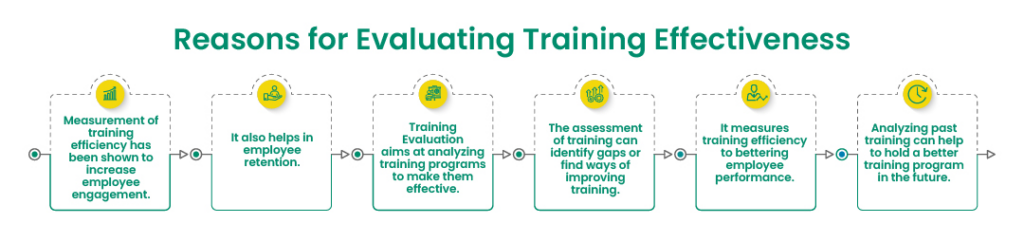
Reasons for Evaluating Training Effectiveness
Statistics show the importance of staff training across the globe. But as useful as it is, training programs are costly too. So ensuring that money was well spent is a priority for employers. It can be done by measuring training effectiveness. Through feedback, training providers and human resource managers can determine how successful their training programs are at achieving the desired results. There are so many reasons for conducting a training evaluation. Below are some of those incentives:
Phases to Evaluate the Effectiveness of Training Programs
The evidence is strong for the link between training and exceptional performance. Still, surprisingly, 9% of organizations surveyed to be found no connection between the training performed and business effectiveness. It is not only a waste of resources and money but also a negligence of actual problems that need to be addressed. So how can we measure the effectiveness of training? Well, to evaluate the effectiveness of programs, one needs to-
Choose the Appropriate Training Evaluation Models
There are several training evaluation models that concentrate on particular aspects. The optimal model for your evaluation needs must be chosen before you can begin evaluating training materials. The three models listed below are widely used by businesses worldwide to evaluate training programs in order to maximize return on investment. The models are as follows:
The Kirkpatrick Taxonomy:
Probably the most widely used method of evaluating training effectiveness is The Kirkpatrick Taxonomy. It evaluates learning techniques, both official and unofficial, and ranks them according to four levels of standards: response, knowledge, behavior, and outcomes.
The Phillips Return on Investment ROI Methodology:
This method can be described as an extension of the Kirkpatrick taxonomy as it builds on it. With the usual factors of Reaction, Learning, Application, and Implementation of training, the Phillips ROI model also has an additional one, the “Impact ROI”. Adding the fifth layer to determine the ROI of each program, it makes the financial advantage obvious for enterprises.
This extra level contrasts the results of learning and its effects on the company. At all levels of the training program’s evaluation metrics, the Phillips Methodology separates the impacts of the program from other training objectives to calculate the precise net financial advantages of each learning program.
The CIPP Evaluation Model:
The Context, Input, Process, and Product (CIPP) assessment model from Stufflebeam is suggested to comprehensively evaluate the creation, planning, execution, and evaluation of learning programs, and offer knowledge of focus groups, and criticism to measure the project’s potential for further improvement. One of the benefits of the CIPP model is that it may be a helpful tool for evaluators to create questions that are crucial to ask during an evaluation process. Many questions may be formulated by executives for employee training assessment.
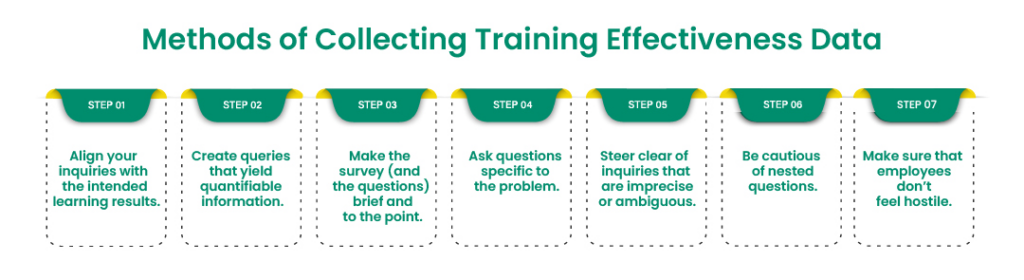
Choose the Right Method of Collecting Data
Training Evaluation methods are methods for collecting data. Once the training needs evaluation method is settled, a subsequent step is to identify the best method and tools to collect the required information about the training program. After choosing a method the practitioner can start collecting data. Following are the commonly used data collection issues for evaluation techniques that you need to have knowledge about.
Determine Indicators of Training Effectiveness
A practitioner of the training program should first identify indicators to give you the knowledge of effectiveness in evaluating corporate training programs. Without the proper indicators searching List some categories that will help you assess the effectiveness of training.

Analyze Data
The last step to measure training effectiveness will be documenting the findings from the corporate training assessment process and analyzing them. The results obtained from the training evaluation will help improve the organization’s approach to the training courses.
Training Evaluation Template by Using Kirkpatrick Evaluation Model
Training evaluations provide the best way to measure training effectiveness and ensure the training course actually helps the employee get better at what they do. The company has the ability to improve its employee learning outcomes by analyzing how employee training needs to be monitored and they use various models for it.
In the previous section, we learned about The Kirkpatrick Model to measure training effectiveness. It was developed in the 1950s by Professor Donald Kirkpatrick in Wisconsin. This 4-level approach is among the best ways to measure the effectiveness of customized company training. These are:
Level 1 – Response
These levels measure how people respond to training in assessing their effectiveness and relevance using surveys or questionnaires for feedback before the training or during training. You should be able to understand how well your training has been received as well as identify any gaps in the training content.
Level 2 – Learning
To evaluate the effectiveness of training at this level, you may combine various measurement tools depending on the stage of assessment. You must determine if the training is meeting its objectives, and what specific skills can be acquired through this training.
Level 3 – Behavior
This level helps in finding out how the training affects employees’ performance and attitudes towards work activities to evaluate the effectiveness of the training on the learner’s performance.
Level 4 – Results
This is the last step where the results are weighed measuring tangible benefits from training. Some of the indicators of effective training include:
a) Lower expenses,
b) Enhanced quality,
c) Faster project completion,
d) Satisfying Customer interaction,
e) Increased productivity,
f) Increased sales,
g) Increased morale.
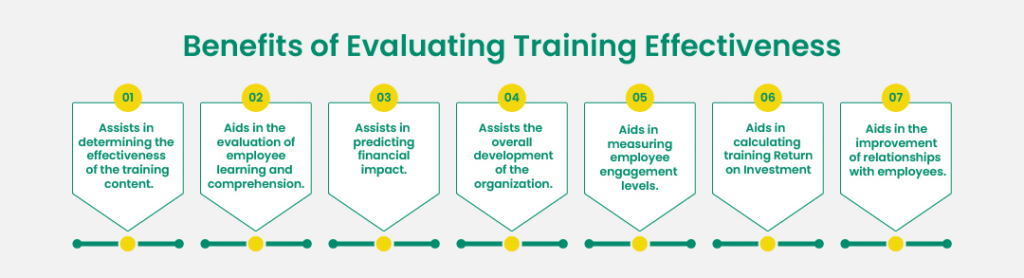
Benefits of Evaluating Training Effectiveness
Training evaluations provide a thorough evaluation of the training’s usefulness and success. It helps training program managers to measure the skills gap and comprehend the expected outcomes. Evaluation serves as a check to guarantee that the training can address skill gaps in the organization in a cost-effective manner. This is especially significant given that organizations are attempting to decrease expenses while increasing globally. It is also advantageous for many more reasons such as:
Conclusion
No one can deny how important training programs are for employees as individuals to employers and the company development. Training evaluations are also included into any learning management system. But to reap the coveted fruits, you must sow the right seeds. This is where an evaluation of training programs helps immensely.
Understanding the goals of a business and the needs of employees, making plans to achieve those and assessing the potency of the training by reviewing results will take the company one step closer to the summit.
Frequently Asked Question (FAQ)
How to measure training effectiveness?
- Training effectiveness with the help of various evaluation metrics.
What are training evaluation metrics?
- Some training evaluation metrics are Employee performance, Enhanced Productivity, and Better Job Satisfaction.
What is training evaluation?
- Training evaluation is a crucial aspect of businesses since that helps measure the effectiveness of training program design.
Why is training important?
- When employees are trained to be efficient with proper tools and techniques, they produce optimum organizational results.
Why are corporate Training Metrics important?
- The training metrics help companies identify areas where training can be improved or improve employee satisfaction. The company can ultimately accomplish its business goals through the proper training of its workers.