
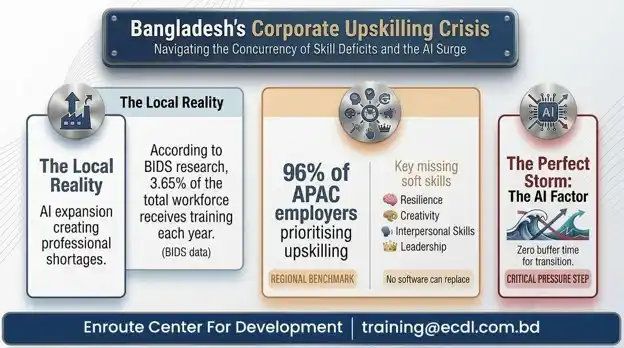
Bangladesh’s corporate sector is growing, but workforce capability is struggling to keep pace. In Bangladesh’s corporate sector, adequate upskilling training is at an inflection point. According to BIDS research, only 3.65% of the workforce receives training each year. In sectors like RMG and construction, that figure falls below 1%.
The regional picture adds urgency. Across the Asia-Pacific, though, 96% of employers are actively prioritising upskilling, yet the skill gaps they report are not primarily technical. Soft skills like resilience, creativity, leadership, and interpersonal skills are the prime skills that are found to be missing, the capabilities that no software can replace.
AI is accelerating the pressure further. Its expansion is creating a severe shortage of qualified professionals across technical and data-driven roles, and the skills deficit and the technology surge are arriving simultaneously.
For HR and L&D leaders in Bangladesh, the implication is straightforward: structured corporate training is no longer optional.
Yet most organizations here still lack the infrastructure to act on that. Studies consistently show that Bangladeshi companies cycle through ad-hoc workshops with no Training Needs Analysis, no learning objectives tied to business outcomes, and no measurement of whether anything worked.
This guide is written for HR managers, L&D heads, and CLOs who want to change that. By the end, you will have a clear picture of:
- The L&D landscape in Bangladesh
- The training types that matter most in the industry
- A step-by-step framework for building a corporate training strategy
- The criteria for selecting the right training partner
In short, an entire guideline in one place on corporate training procedures and their potential to enhance progress in organizational dynamics.
In This Guide
- The State of Corporate Training in Bangladesh
- Types of Corporate Training Programs in Bangladesh
- How to Build a Corporate Training Strategy in Bangladesh
- Top Corporate Training Companies in Bangladesh
- Trends Shaping L&D in Bangladesh (2026 and Beyond)
- Frequently Asked Questions
The State of Corporate Training in Bangladesh
Overview of the L&D Landscape
Corporate training in Bangladesh has evolved significantly over the past decade. What was once confined to classroom-based induction programs in large banks and MNCs has expanded into a multi-sector industry spanning RMG, telecom, FMCG, fintech, and professional services.
Several institutional forces are shaping this expansion, among those, the learning and developing center, like Enroute Center for Development, is playing an invaluable role.
Bangladesh Bank mandates AML and compliance training for the financial sector. BGMEA runs structured capability programs for RMG supervisors and mid-level managers. BASIS supports skills development for software and IT service companies.
Post-2020, the shift toward blended and digital learning, accelerated by the pandemic, has further broadened access, particularly for organizations with distributed workforces across Dhaka, Chittagong, and beyond.
Key Workforce Development Challenges
Despite this growth, Bangladesh’s corporate training market faces structural challenges that HR leaders must take care of:
- Skill gap between academic output and industry needs. A BIDS Labor Market study projects a skilled workforce gap of around 7 million by 2025. University graduates frequently lack the practical and soft skills employers require; as a result, 93% of surveyed companies operate in-house training programs.
- Limited L&D budgets in SMEs and mid-market companies. Large MNCs and listed conglomerates invest systematically in L&D. The majority of Bangladesh’s mid-market employers treat training as a cost rather than an investment, resulting in ad-hoc, reactive programs.
- Language and digital literacy barriers. In blue-collar and peri-urban segments, Bangla-language training content and mobile-first delivery are essential. But remain underdeveloped by most training providers.
- Shortage of certified L&D professionals. Demand for CIPD- and SHRM-credentialed L&D practitioners in Bangladesh exceeds supply, leaving many HR functions without the expertise to design or evaluate training programs effectively.
Types of Corporate Training Programs in Bangladesh
Onboarding and Induction Training
Structured orientation programs for new hires are standard practice in Bangladesh’s banking sector, telecommunications companies, and multinational operations in Dhaka. An effective onboarding experience delivers three things: cultural immersion, compliance essentials, and hands-on systems training. The ultimate payoff comes in the form of early turnover and keeping retail banking firms from the heavy financial drain of constant rehiring.
Leadership and Management Development
Corporate training for top and middle managerial roles is the fastest-growing training segment in Bangladesh’s corporate sector. As organizations mature and expand, the gap between frontline supervisors and senior leadership becomes a critical bottleneck. Programs focused on people management, decision-making, and business communication are in high demand across FMCG, banking, and telecom.
Compliance and Regulatory Training
Regulatory training is non-negotiable in several sectors. Banking and financial services organizations must deliver Anti-Money Laundering (AML) and Know Your Customer (KYC) training annually. RMG factories face audit requirements covering labour law, fire safety, and BNBC building codes. BGMEA and international buyer programs (such as those run by ACCORD and NIRAPON) further drive structured compliance training across the supply chain.
Technical and Functional Skills Training
Industry-specific technical training varies significantly by sector. In RMG, lean manufacturing, quality control, and industrial engineering programs are delivered on the factory floor. In IT and software, technical upskilling covers full-stack development, cloud platforms, and agile methodologies. FMCG companies invest heavily in sales capability and distributor management training for their field forces.
Soft Skills and Communication Training
Business English, presentation skills, and customer service training are consistently in high demand across Bangladesh’s BPO, banking, and professional services sectors. A 2025 Economic Intelligence Bangladesh survey found that leadership and teamwork were the top soft-skill priorities for Dhaka’s corporate employers, with analytical thinking and critical problem-solving rising fast as digital transformation accelerates.
Digital and E-Learning Programs
LMS adoption is growing in Bangladesh, particularly among MNCs and larger domestic companies. Global platforms like Moodle and Talent LMS are in use, though localization remains a challenge — most content is in English, limiting effectiveness in frontline and blue-collar roles. Local training providers are beginning to develop Bangla-language digital content, which represents a significant market opportunity.
How to Build a Corporate Training Strategy in Bangladesh
A well-structured corporate training strategy generally follows five sequential steps. As you can see, the following numbered framework features the process of building a training program in Bangladesh. More importantly, this process can be adopted by HR leaders in any organization that replaces ad-hoc training with a measurable L&D investment and can be used repeatedly for fresh cohort training.
Step 1 — Conduct a Training Needs Analysis (TNA)
A TNA is the foundation. Without it, training spend is based on assumptions rather than evidence. A robust TNA for a Bangladesh context includes:
- Role-wise competency mapping against current performance data
- Manager interviews to surface team-level skill gaps
- Employee self-assessment surveys
- Review of attrition data, customer satisfaction scores, and productivity metrics
For organizations in regulated industries such as banking, RMG, and pharmaceuticals, the TNA must incorporate upcoming compliance-related observations. Still, in many cases, these observations are missed before planning a training program for corporations in regulated industries.
Step 2 — Set Learning Objectives and KPIs
Every training program must have objectives that align with business priorities that management cares about. The Kirkpatrick Model provides a practical framework that can measure the business impact of learning on employees. For example, this model measures Reaction among participants (did participants find it valuable?), Learning (did knowledge or skill increase?), Behavior (are they applying it on the job?), and Results (has it moved a business metric?).
In practice, most Bangladeshi organizations measure only Reaction, which is the post-training feedback form. The organizations that extract the most value from training are those that tie Level 3 (Behavior) and Level 4 (Results) metrics to specific business KPIs before the training is designed.
Step 3 — Choose the Right Training Format
Format choice depends on audience, content type, and operational constraints:
- Classroom / face-to-face: Best for leadership programs, high-stakes compliance training, and workshops requiring live discussion. Standard in banking, RMG senior management, and MNC L&D programs.
- Online / LMS-based: Effective for compliance refreshers, onboarding modules, and scalable content delivery. Cost-efficient for organizations with multiple locations across Dhaka, Chittagong, and beyond.
- Blended: The most effective format for most Bangladeshi corporate contexts — combining live sessions for interaction with digital modules for flexibility. Bangla-language content is critical for non-English-dominant roles.
Step 4 — Select a Training Partner or Build In-House
The decision to outsource or build an internal L&D capability depends on training volume, budget, and the complexity of subject matter. When evaluating external training providers in Bangladesh, apply this checklist:
✓ Relevant industry experience and sector-specific case studies
✓ Certified facilitators (CIPD, SHRM, or recognized local credentials)
✓ Demonstrated ability to customize programs
✓ Post-training reinforcement support (coaching, manager briefings, digital follow-up)
✓ Clear measurement methodology aligned to your KPIs
✓ Bangla-language capability where required
Step 5 — Measure ROI and Learning Effectiveness
Use a simple ROI formula HR leaders can present to the C-suite:
Training ROI (%) = [(Business Benefit – Training Cost) ÷ Training Cost] × 100
Business benefit is the hardest variable to measure. Still linking training employees to a specific productivity metric, for example, output per line worker, sales conversion rate, error reduction, before the program begins, gives you the data needed for a credible post-training evaluation.
Top Corporate Training Companies in Bangladesh
What to Look for in a Training Partner
With a growing number of local and international corporate training providers active in Dhaka, HR leaders need a structured approach to vendor evaluation:
- Client references in your specific industry, not just a general portfolio. When a client refers to a vendor, that means they are satisfied with the service. Depending on a shiny portfolio is not wise if you are expecting effective improvement in the performance of your employees.
- Facilitator-to-participant ratios and whether the same lead facilitator delivers throughout the training program.
- In many cases, training providers promise to deliver content as per decisions made over prior discussion with the client company, but later, such promises might not be kept. To avoid such inconvenience, you must sit with the vendor and agree on the issues, training content, methodology, format, expected trainer, etc., through paperwork.
- The flexibility in scheduling the training program must be pre-decided as well. Whether programs can be delivered in-factory, in-office, or across multiple sites
In the L & D industry, Enroute Center for Development (ECDL), a pioneering corporate training company, sets the bar high when it comes to organizing and conducting corporate training programs, whether it is delivered in-house or online, customized or open training programs, even personal coaching, and their signature training programs like leadership, sales, and other skill-based programs are severed as high on demand.
Types of Training Providers in Bangladesh
The corporate training provider landscape in Bangladesh spans several categories:
Local consultancy and corporate L&D entity:
Specialist firms focused on executive education, mostly covering corporate knowledge, leadership, soft skills, and HR capability for executives and managerial roles. These providers offer the highest level of customization and local corporate cultural fluency.
International firms with a Bangladesh presence:
Global L&D brands or regional consultancies operating through local partners. Well-suited for MNCs seeking globally aligned programs with local delivery.
University-industry programs:
IBA (Institute of Business Administration), NSU, BRAC University, and East West University offer executive education and short-course programs relevant to mid-senior managers.
Chamber and industry bodies:
DCCI, MCCI, and BGAPMEA offer short courses and certification programs, often at accessible price points for SMEs and mid-market companies.
Trends Shaping L&D in Bangladesh (2026 and Beyond)
Several trends are reshaping how organizations approach corporate training in Bangladesh:
- Mobile-first learning. With smartphone penetration continuing to rise, LMS adoption is accelerating, particularly for organizations with field forces or factory-floor workers who cannot access desktop-based training.
- AI-powered personalized learning. Early-adopter MNCs are beginning to deploy AI-driven learning path tools that adapt content and pacing to individual learner performance. This is nascent in Bangladesh but growing fast among corporate houses and corporate training provider organizations like ECDL.
- Microlearning and video-based content. Day-long workshops are giving way to 5 to 15-minute modular video content that fits into working schedules. This format is especially effective for compliance refreshers and sales skill reinforcement.
- Government-led skills investment. SEIP (Skills for Employment Investment Program) has trained over 300,000 workers since 2015. The a2i initiative under the ICT Division continues to expand digital skills access. HR leaders at companies in SEIP-covered sectors can leverage government co-funding for eligible programs.
- Rising demand for certifications. PMP, SHRM-CP, CIPD Level 5, and Six Sigma credentials are increasingly sought by Dhaka’s HR and project management communities. Organizations that fund certification programs report stronger retention among high-potential employees.
- Cross-border L&D. MNCs are bringing global learning programs to their Bangladesh teams — normalizing digital collaboration tools, global leadership frameworks, and English-language business communication as standard corporate expectations.
Frequently Asked Questions
| Question | Answer |
| What is corporate training in Bangladesh? | Structured learning programs delivered by organizations to develop employee skills, knowledge, and performance aligned to business goals. In Bangladesh, this spans industries from RMG and banking to tech and FMCG, encompassing onboarding, compliance, leadership, technical, and soft-skills programs. |
| Which industries invest most in training in Bangladesh? | Banking and financial services, RMG, telecom, FMCG, and the growing tech and BPO sectors lead corporate training investment in Bangladesh. MNCs operating in Dhaka also drive demand for leadership development and compliance training across their local teams. |
| What is the role of HR in training & development? | HR acts as the bridge between business strategy and people capability — owning the Training Needs Analysis, vendor selection, learning logistics, budget management, and ROI measurement. In mature L&D functions, HR partners directly with department heads to tie training outcomes to business KPIs. |
| Are there government-supported training programs? | Yes. NSDA, and the a2i initiative under the ICT Division offer subsidized skills training for both formal and informal sector workers. Bangladesh Bank also mandates or incentivizes sector-specific training for their member organizations. |
| What training formats work best in Bangladesh? | Blended learning — combining face-to-face sessions with digital modules — delivers the best results across most industries. Bangla-language content significantly increases engagement in non-English-dominant roles. Mobile-first delivery is growing fast as smartphone penetration rises across urban and peri-urban workforces. |
Conclusion
Bangladesh’s corporate training market is maturing, and the organizations that invest in structured L&D now are building a durable competitive edge in talent retention, productivity, and regulatory resilience.
The path forward is not complicated. Start with a Training Needs Analysis to replace assumptions with evidence. Set objectives tied to business outcomes. Choose formats and partners that fit your industry and workforce reality. And measure what matters — not just whether participants enjoyed the session, but whether the business moved.
If you are building or restructuring your L&D function and would like expert guidance on Training Needs Analysis, program design, or identifying the right training partners in Bangladesh, our HR consulting team is here to help.
Talk to an L&D consultant | Explore our corporate training programs